
- Introduction: A Revolution in Bioprinting
Imagine a future where life-saving organ transplants no longer rely on donor availability, where drug testing is performed on bioprinted human tissues instead of animals, and where sustainable, lab-grown meat reduces our environmental footprint. This future is rapidly becoming a reality, thanks to 3D bioprinting—a revolutionary technology that combines the precision of 3D printing with the complexity of biological materials.
At its core, 3D bioprinting involves layering bio-inks, substances made of living cells and biomaterials, to create structures that mimic natural tissues. From skin grafts for burn victims to functional organ prototypes, the possibilities are staggering. But 3D bioprinting’s impact extends far beyond medicine. It offers solutions to global challenges in food security, pharmaceutical development, and sustainability.
In this article, we will explore the fascinating evolution of 3D bioprinting, the opportunities it presents across industries, the challenges it faces, and its potential to reshape humanity’s future.
- A Brief History of 3D Bioprinting
The journey of 3D bioprinting began with the convergence of two groundbreaking fields: 3D printing technology and tissue engineering. In the early 2000s, researchers started experimenting with adapting 3D printing processes to biological materials. The goal was audacious, to create structures that could replicate the complexity of living tissues. While the initial results were rudimentary, they paved the way for a new frontier in biotechnology.
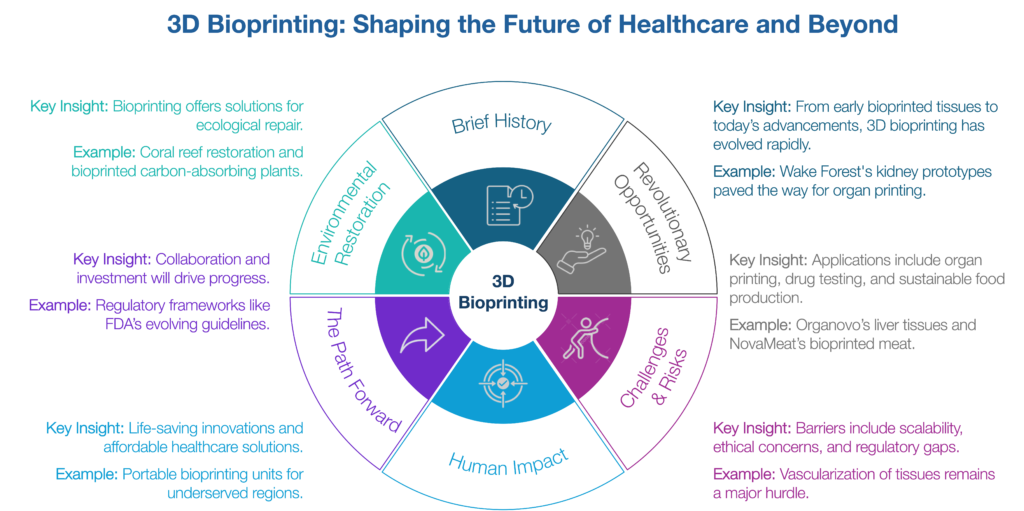
One of the earliest milestones came in 2009, when Harvard researchers successfully bioprinted functional blood vessels. This breakthrough demonstrated the potential of 3D bioprinting to create vascularized tissues, a critical challenge in tissue engineering. Shortly after, companies like Organovo emerged, pushing bioprinting into commercial applications. Organovo’s bioprinted liver tissues, designed for drug testing, were among the first examples of bioprinting moving beyond research labs into practical use.
In the years that followed, advances in bio-inks, specialized materials made of living cells and biomaterials, expanded the possibilities of 3D bioprinting. Researchers began experimenting with different cell types, creating skin tissues for burn victims, cartilage for joint repair, and even prototypes of human organs like kidneys. By 2018, Wake Forest Institute for Regenerative Medicine had developed bioprinted kidney prototypes, signaling a future where organ transplants might no longer depend on donor availability.
As the technology evolved, its applications broadened beyond healthcare. The food industry began leveraging bioprinting to address sustainability challenges, with companies like NovaMeat creating plant-based, bioprinted meat products. These advancements showcased the versatility of 3D bioprinting, positioning it as a transformative force in multiple sectors.
Today, 3D bioprinting stands at the intersection of science fiction and reality. What once seemed like an ambitious dream is now a rapidly developing field with profound implications for medicine, sustainability, and innovation. From blood vessels to bioengineered meat, the history of 3D bioprinting reflects humanity’s ability to push the boundaries of what is possible.
- Revolutionary Opportunities
3D bioprinting holds transformative potential across multiple industries, offering solutions to longstanding challenges in healthcare, pharmaceuticals, and sustainability. By enabling the creation of complex biological structures, this technology bridges gaps that traditional methods cannot address. Below are some of the most promising opportunities, supported by real-world use cases.
- Medical Applications: The Promise of Custom Organs and Tissues
One of the most compelling opportunities in 3D bioprinting lies in addressing the global shortage of organs for transplantation. Researchers at Wake Forest Institute for Regenerative Medicine have developed bioprinted kidney prototypes, demonstrating the feasibility of printing functional organ structures. While not yet suitable for implantation, these prototypes provide a critical step toward solving the organ donation crisis.
In burn treatment, bioprinted skin offers a revolutionary approach. Companies like Poietis have developed techniques to bioprint layers of skin tissue for use in grafting, allowing for customized treatments that improve healing outcomes. These applications highlight the potential for 3D bioprinting to not only save lives but also improve the quality of care for patients.
- Pharmaceutical Advancements: Transforming Drug Development
3D bioprinting is also reshaping pharmaceutical research. One notable application is in the creation of bioprinted human tissues for drug testing, which reduces reliance on animal testing and improves accuracy. Organovo, a pioneer in this space, has developed liver tissues that pharmaceutical companies use to test drug toxicity and efficacy. These bioprinted tissues mimic human physiology, offering a more reliable and ethical alternative to traditional testing methods.
Moreover, advancements in bio-inks have enabled the creation of tissue models specific to diseases, allowing researchers to study conditions like cancer in ways previously impossible. This precision not only accelerates drug development but also reduces costs, benefiting both companies and patients.
- Sustainability in Food Production: A Greener Future
Beyond healthcare, 3D bioprinting is making waves in the food industry. Companies like NovaMeat and Redefine Meat are using bioprinting techniques to create plant-based meat products that replicate the texture and taste of animal-derived foods. These innovations address critical sustainability challenges, including the environmental impact of traditional meat production.
For example, NovaMeat’s bioprinted steaks are made from plant proteins and have been marketed as a sustainable alternative to conventional beef. By reducing land, water, and greenhouse gas emissions associated with livestock farming, bioprinting offers a scalable solution to feed a growing global population without exacerbating environmental degradation.
- Personalized Healthcare: The Future of Prosthetics and Implants
3D bioprinting enables the customization of prosthetics and implants, tailoring them to individual patients. This level of precision is especially beneficial for complex medical cases, such as cranial implants for trauma victims or dental prosthetics for patients with unique oral structures. Bio-compatible materials ensure these implants integrate seamlessly with the body, reducing complications and improving outcomes.
- Challenges and Risks
Although 3D bioprinting holds immense promise, its path to widespread adoption is marked by significant technical, ethical, and regulatory obstacles. Overcoming these hurdles is essential to fully realizing its potential and ensuring its applications are both impactful and accessible to all.
- Technical Challenges: From Complexity to Scalability
One of the most significant barriers to 3D bioprinting is the complexity of replicating the structures and functions of living tissues. For instance, creating vascularized tissues—those with blood vessels capable of delivering nutrients and oxygen—is an ongoing challenge. Without vascularization, large bioprinted structures cannot survive or function effectively.
Another hurdle is scalability. While researchers have successfully printed small tissue samples, scaling these technologies to produce fully functional organs or large quantities of bioprinted food remains a monumental task. Materials like bio-inks must be fine-tuned to mimic the mechanical and biological properties of native tissues, which is both costly and time-intensive.
- Ethical Dilemmas: Who Gets Access?
As with many emerging technologies, 3D bioprinting raises ethical concerns. For instance, if bioprinted organs become available, who will have access to them? Will they only be affordable for the wealthiest individuals or countries, exacerbating existing healthcare inequalities?
Additionally, there are philosophical and moral questions about the implications of creating synthetic living tissues. How should society regulate and define the ethical boundaries of bioprinting? These dilemmas underscore the need for proactive dialogue and policies that ensure equitable access and responsible innovation.
- Regulatory Barriers: A Framework in Progress
The lack of standardized regulatory frameworks is another significant barrier. For example, the U.S. Food and Drug Administration (FDA) has approved bioprinted products for limited applications, such as bone implants, but broader adoption in areas like organ transplantation or pharmaceuticals is still unregulated. Establishing safety, efficacy, and quality standards for bioprinted tissues and organs is essential to gaining public trust and commercial viability.
Moreover, different countries are at varying stages of regulatory development, which could lead to a fragmented global market. Companies navigating these inconsistencies face increased costs and delays, further complicating commercialization.
- Risks of Misuse: A Double-Edged Sword
Like any powerful technology, 3D bioprinting carries the risk of misuse. In the wrong hands, it could be exploited for unethical purposes, such as creating harmful biological materials. Safeguards must be implemented to prevent malicious applications while encouraging beneficial innovation.
- The Human Impact: A Glimpse Into the Future
As 3D bioprinting continues to evolve, its potential applications stretch into transformative possibilities that could redefine human life. Imagine a future where hospitals maintain “bio-banks” of organ blueprints, allowing doctors to print replacement kidneys, livers, or even hearts on demand, customized to each patient’s genetic makeup. Such advancements could make organ waitlists obsolete and drastically improve survival rates for critical illnesses.
In rural and underserved regions, mobile bioprinting units could provide life-saving treatments on-site, such as printing skin grafts for burn victims or bone structures for trauma patients. These units, equipped with compact bioprinters and bio-ink cartridges, could bring advanced medical care to populations that currently lack access to basic healthcare infrastructure.
Beyond medicine, entire ecosystems could be regenerated using bioprinting. Scientists could bioprint coral reefs to restore marine biodiversity or develop bioengineered plants that absorb more carbon dioxide, tackling climate change in innovative ways. Additionally, sustainable bioprinted food products might become a cornerstone of addressing global hunger, providing protein-rich, eco-friendly alternatives to millions.
This glimpse into the future highlights how 3D bioprinting might not only alleviate existing challenges but also open doors to entirely new possibilities. By pushing the boundaries of what is possible, it offers a vision of a world that is healthier, more equitable, and better equipped to meet the challenges of tomorrow.
- The Path Forward: Collaboration and Innovation
The future of 3D bioprinting depends on a coordinated effort among key stakeholders, including researchers, businesses, governments, and regulatory bodies. While the technology holds immense promise, realizing its full potential requires overcoming significant barriers through collaboration, investment, and innovation.
A critical first step is increasing funding for research and development to address current technical challenges, such as scalability and vascularization. Public and private sector partnerships can accelerate breakthroughs, as seen with organizations like Wake Forest Institute for Regenerative Medicine collaborating with industry leaders. Governments can play a vital role by offering grants, subsidies, and tax incentives for bioprinting initiatives, ensuring long-term progress.
Regulatory frameworks must evolve to keep pace with the rapid advancement of bioprinting technologies. Establishing global standards for safety, efficacy, and ethical considerations will provide clarity and encourage innovation. Regulatory bodies like the FDA, EMA, and WHO should work collaboratively to create cohesive guidelines that enable commercialization while maintaining public trust.
Education and workforce development are also paramount. Universities and technical institutions must design curricula to train the next generation of bioengineers, biotechnologists, and regulatory experts. Initiatives like these will ensure a steady pipeline of skilled professionals capable of driving the field forward.
Finally, fostering a culture of ethical innovation will be essential. Transparent discussions about the societal implications of 3D bioprinting, such as equitable access and potential misuse, will help build trust and support for its adoption. Collaboration across disciplines—combining expertise in engineering, biology, ethics, and policy—will be key to ensuring the technology is developed and deployed responsibly.
With the right investments and cooperative efforts, 3D bioprinting can overcome its current hurdles and reshape industries ranging from healthcare to sustainability. The path forward is not just about technological progress; it is about building a future where the benefits of this groundbreaking innovation are shared equitably across the globe.
- Conclusion: Embracing the Bioprinted Future
3D bioprinting stands at the cusp of revolutionizing industries, bridging science fiction and reality. Its potential to address critical challenges in healthcare, sustainability, and beyond is unmatched, offering a glimpse of a world where organ shortages, unethical drug testing, and unsustainable food systems could be relics of the past.
However, the journey to realizing this vision is neither simple nor guaranteed. Overcoming technical challenges, establishing robust ethical and regulatory frameworks, and ensuring equitable access are all essential steps. The path forward requires bold investment, interdisciplinary collaboration, and a commitment to innovation that prioritizes the well-being of humanity and the planet.
As we look ahead, 3D bioprinting represents more than a technological breakthrough—it is a tool to create a healthier, more sustainable, and equitable future. By embracing this transformative potential responsibly, we have the opportunity to redefine the boundaries of what is possible and leave a lasting impact for generations to come.
References
- Wake Forest Institute for Regenerative Medicine: “3D Bioprinting Kidney Tissues for Research and Transplantation.” Website: https://school.wakehealth.edu
- Nature Biotechnology: “Advances in Bioprinting Vascularized Tissues.” Website: https://www.nature.com/nbt
- Organovo: “Bioprinted Human Liver Tissues for Drug Testing Applications.” Website: https://www.organovo.com
- Science Advances: “Bioprinted Skin Grafts for Burn Victims.” Website: https://advances.sciencemag.org
- Poietis: “Bioprinting Functional Skin Layers for Personalized Medicine.” Website: https://poietis.com
- Advanced Healthcare Materials: “Bio-Inks for 3D Bioprinting Applications.” Website: https://onlinelibrary.wiley.com
- Redefine Meat: “Bioprinted Plant-Based Steaks and Food Sustainability.” Website: https://www.redefinemeat.com
- NovaMeat: “Creating Bioprinted Meat for a Sustainable Future.” Website: https://www.novameat.com
- BBC News: “3D Bioprinting Organs: Where Science Meets Medicine.” Website: https://www.bbc.com
- Forbes: “How Bioprinting is Transforming Drug Testing and Personalized Medicine.” Website: https://www.forbes.com
- MIT Technology Review: “The Challenges and Opportunities of Bioprinted Organs.” Website: https://www.technologyreview.com
- Harvard Business Review: “Bioprinting and Its Ethical Implications in Healthcare.” Website: https://hbr.org
- Science Direct: “Vascularization in Bioprinted Tissues: Challenges and Innovations.” Website: https://www.sciencedirect.com
- FDA Bioprinting Guidelines: “Regulatory Framework for Bioprinted Medical Products.” Website: https://www.fda.gov
- World Economic Forum: “3D Printing and Its Role in Sustainable Development.” Website: https://www.weforum.org
- GE Additive: “Bioprinting Innovations in Personalized Healthcare.” Website: https://www.ge.com/additive
- Siemens Healthineers: “The Intersection of 3D Printing and Regenerative Medicine.” Website: https://www.siemens-healthineers.com
- IKEA Sustainability: “The Role of Bioprinting in Sustainable Food Systems.” Website: https://www.ikea.com/sustainability
- Gartner: “Emerging Trends in 3D Printing and Biomanufacturing.” Website: https://www.gartner.com
- World Health Organization (WHO): “The Future of Bioprinting in Global Health.” Website: https://www.who.int