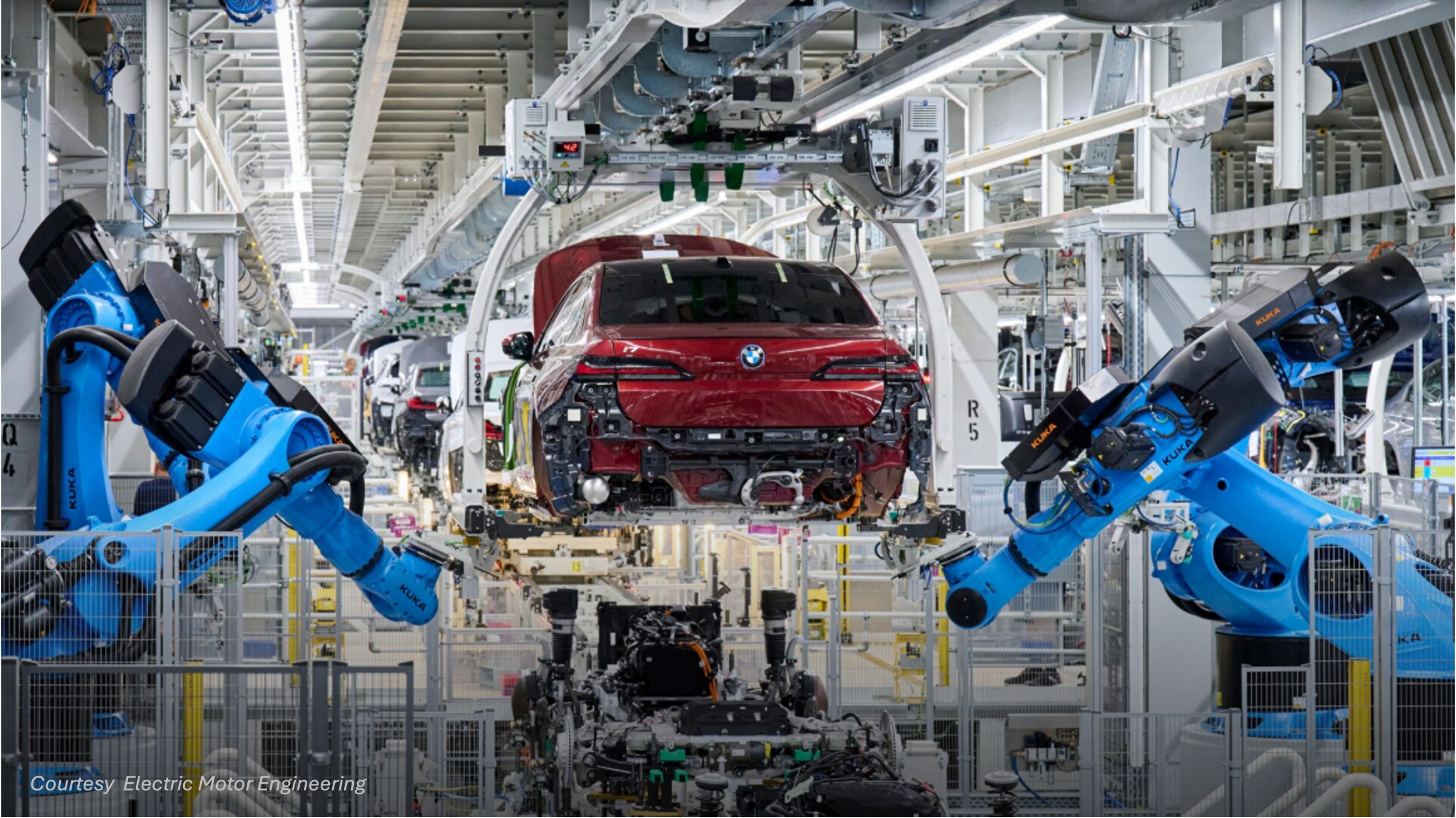

How do you build the factory of tomorrow without disrupting the factories of today? For BMW, this question became existential as the automaker prepared to launch its most ambitious product transformation in decades. Operating more than 30 production facilities globally and manufacturing 2.5 million vehicles annually with 99 percent built to individual customer specifications, BMW faced a coordination challenge of staggering complexity. The company’s response was the iFACTORY concept, a strategic framework built on three pillars: LEAN, GREEN, and DIGITAL. At its core lies the most comprehensive implementation of Digital Twins in Manufacturing ever attempted in the automotive industry. BMW’s approach offers a blueprint for industrial transformation, demonstrating how virtual-first planning can compress timelines, reduce costs by up to 30 percent, and fundamentally change how complex production systems evolve.
Why Virtual-First Became Non-Negotiable
The scale of BMW’s challenge came into sharp focus with a single number: 40. Between now and 2027, the automaker must integrate more than 40 new or updated vehicle models into its global production network, including the entirely new Neue Klasse electric platform that represents the company’s future. Traditional approaches to production planning had reached their limits. Physical testing of line changes required weeks of modifications, plant shutdowns, and engineering teams traveling between continents. Consider the collision check, the critical process of verifying that a new vehicle model fits existing production infrastructure without interference. Using conventional methods, this verification required up to four weeks of physical testing. Entire plant sections had to be cleared while engineers moved vehicles through production sequences manually.
The market context made delay impossible. The global market for digital twin software, platforms, and integration services is projected to grow from $21 billion in 2025 to nearly $150 billion by 2030, reflecting a compound annual growth rate of 47.9 percent. Manufacturers who postpone adoption risk structural disadvantage against competitors already capturing efficiency gains. BMW’s decision was unambiguous: build the new Debrecen plant in Hungary entirely in virtual space before breaking physical ground. In March 2023, the facility achieved virtual start of production more than two years before actual operations began, becoming the world’s first factory planned and validated completely through simulation.
Building the Digital Foundation
The technical architecture enabling BMW’s transformation centers on the NVIDIA Omniverse platform, which allows real-time 3D collaboration across geographies and time zones. But platform selection was only the beginning. The deeper challenge involved connecting building data, equipment data, logistics data, vehicle data, and 3D simulations of manual work processes into unified digital representations of every facility. Since November 2020, BMW has scanned more than seven million square meters of indoor space and 15 million square meters of outdoor production areas using NavVis mobile mapping technology. This scanning initiative captured every structure, piece of equipment, and outdoor area across the global production network with millimeter precision.
The resulting digital infrastructure now serves 15,000 BMW employees through a cloud-based application called Factory Viewer. Engineers conduct virtual site inspections, take precise measurements, and evaluate planning alternatives without leaving their desks. For more sophisticated work, BMW developed FactoryExplorer, a custom application built on Omniverse technologies that enables logistics and production planners to optimize layouts, simulate processes, and validate changes in real time. Factory planners now make an average of three changes per week across more than 30 facilities, with each modification tested virtually before physical implementation. The platform continues evolving as BMW integrates generative and agentic AI functionalities to enable increasingly autonomous optimization. This architectural depth explains why Digital Twins in Manufacturing demand more than software procurement. Simulation accuracy depends entirely on data fidelity across every connected system.
AIQX: When Digital Twins Meet the Production Line
While virtual planning transformed how BMW designs production systems, a parallel initiative demonstrated how Digital Twins in Manufacturing enhance ongoing operations. AIQX, which stands for Artificial Intelligence Quality Next, is BMW’s proprietary IT platform for automated visual inspection. The Regensburg plant became the first automotive facility in the world to deploy end-to-end digitalized and automated surface inspection in series production. Since going live in March 2023, the system has validated its effectiveness across more than two years of continuous operation.
The system operates through cameras positioned along production lines that capture images of vehicles as they move through assembly. AI algorithms evaluate each image against patterns learned from hundreds of thousands of previous inspections, identifying anomalies in milliseconds. For painted surfaces, where traditional machine vision struggles with reflective finishes, BMW implemented deflectometry technology. Cameras work alongside monitors displaying striped patterns, with light reflections enabling precise calculation of surface irregularities. Laser projectors then mark detected defects for human review, ensuring no imperfection escapes attention regardless of how minute.
The GenAI4Q pilot project at Regensburg pushed capabilities further. Generative AI now delivers tailored inspection recommendations for each of the approximately 1,400 vehicles produced daily. Because every vehicle is built to individual customer specifications with different drivetrains, equipment levels, and options, no two inspection catalogs are identical. Through partnership with Intel, BMW deployed the OpenVINO toolkit to enable AI workloads on standard desktop PCs, advancing the company’s vision of AI capabilities available to every employee. The critical connection to Digital Twins in Manufacturing lies in how quality data feeds back into digital models. Defect patterns identified on the production line inform design simulations, creating closed-loop learning systems that continuously improve.
The Numbers Behind the Transformation
BMW’s virtual factory initiative has generated quantified results that validate the investment thesis. Production planning costs are projected to decrease by up to 30 percent through virtual-first processes. The collision check that once required four weeks of physical testing now completes in three days through simulation. Design freeze decisions that previously consumed three days of review now happen in approximately one hour through real-time visualization. Broader efficiency metrics demonstrate systemic improvement: 10 to 30 percent reduction in late change costs through reduced planning errors, 10 to 20 percent greater efficiency in best-practice sharing between locations, and 20 to 40 percent reduction in travel costs for industrial engineers who now conduct virtual site visits.
External validation reinforced these outcomes. In October 2024, the Regensburg plant received Germany’s prestigious Factory of the Year award in the category of excellent large-series assembly. Judges from management consultancy Kearney cited the facility’s flexibility, digital innovation, and successful transformation under the iFACTORY framework. BMW also holds membership in the World Economic Forum’s Global Lighthouse Network, which now encompasses 189 production facilities demonstrating Fourth Industrial Revolution leadership. McKinsey research indicates that Digital Twins in Manufacturing can drive revenue increases of up to 10 percent, accelerate time-to-market by as much as 50 percent, and improve product quality by 25 percent.
What BMW Learned Building the Virtual Factory
Several principles emerged from BMW’s implementation that carry relevance for manufacturers at any scale. The initiative began with comprehensive scanning of existing facilities, creating the data foundation upon which everything else depended. Technology selection mattered less than collaboration enablement. NVIDIA Omniverse’s value derived from allowing architects, plant engineers, logistics planners, and robotics teams to work simultaneously in shared virtual environments regardless of physical location.
Standardization proved essential for scale. BMW adopted the Universal Scene Description format, originally developed for the film industry, which allowed integration of data from multiple CAD and engineering tools without compatibility losses or information degradation. Workforce development received equal emphasis. With 15,000 employees now trained on Factory Viewer, technology was designed to augment human expertise rather than replace institutional knowledge. The partner ecosystem expanded deliberately, with NVIDIA, Intel, NavVis, and SAP each contributing specialized capabilities that no single vendor could provide. Perhaps most importantly, BMW treats the Virtual Factory as an evolving platform rather than a completed project. Digital Twins in Manufacturing succeed when conceived as living systems that grow more capable over time.
The Competitive Threshold
BMW’s iFACTORY demonstrates that Digital Twins in Manufacturing have matured from experimental technology to enterprise-critical infrastructure. With more than 40 vehicle integrations planned virtually by 2027, the automaker is establishing a new baseline for production agility that competitors must now match. As the Global Lighthouse Network expands and recognition spreads, manufacturers without comprehensive digital twin strategies face growing disadvantage in cost structure, speed to market, and operational resilience. The convergence of digital twins, generative AI, and autonomous systems points toward a future of factories that increasingly optimize themselves. For industrial leaders watching BMW’s transformation, the question is no longer whether to build the virtual factory. The question is how quickly they can close the gap with those who already have.
References
- BMW Group. “BMW Group Scales Virtual Factory.” BMW Group Press Release, June 2025. https://www.press.bmwgroup.com/global/article/detail/T0450699EN/bmw-group-scales-virtual-factory
- BMW Group. “BMW Group Plant Regensburg wins ‘Factory of the Year’.” BMW Group Press Release, October 2024. https://www.press.bmwgroup.com/global/article/detail/T0445446EN/bmw-group-plant-regensburg-wins-factory-of-the-year
- NVIDIA. “BMW Group Develop Custom Application on NVIDIA Omniverse.” NVIDIA Customer Stories, 2024. https://www.nvidia.com/en-us/customer-stories/bmw-group-develop/
- NVIDIA Blog. “BMW Group Starts Global Rollout of NVIDIA Omniverse.” April 2023. https://blogs.nvidia.com/blog/bmw-group-nvidia-omniverse/
- Intel. “BMW Group: AI on Every Employee’s Laptop.” Intel Customer Spotlight, 2024. https://www.intel.com/content/www/us/en/customer-spotlight/stories/bmw-group-openvino-customer-story.html
- McKinsey & Company. “Digital Twins: The Next Frontier of Factory Optimization.” January 2024. https://www.mckinsey.com/capabilities/operations/our-insights/digital-twins-the-next-frontier-of-factory-optimization
- McKinsey & Company. “Digital Twins: The Key to Unlocking End-to-End Supply Chain Growth.” November 2024. https://www.mckinsey.com/capabilities/quantumblack/our-insights/digital-twins-the-key-to-unlocking-end-to-end-supply-chain-growth
- BMW Blog. “BMW Group’s Regensburg Plant Named ‘Factory of the Year’ 2024.” October 2024. https://www.bmwblog.com/2024/10/24/bmw-regensburg-factory-of-the-year-2024/
- World Economic Forum. “Global Lighthouse Network 2025: World Economic Forum Recognizes Companies Transforming Manufacturing through Innovation.” January 2025. https://www.weforum.org/press/2025/01/global-lighthouse-network-2025-world-economic-forum-recognizes-companies-transforming-manufacturing-through-innovation/
- Automotive Manufacturing Solutions. “Future-ready: BMW’s Digital Transformation of its Munich Plant and Beyond.” March 2025. https://www.automotivemanufacturingsolutions.com/smart-factory/future-ready-bmws-digital-transformation-of-its-munich-plant-and-beyond/46957.article
- Automotive Manufacturing Solutions. “Artificial Intelligence: New Developments in Surface Inspection.” July 2025. https://www.automotivemanufacturingsolutions.com/digitalisation-and-automation/artificial-intelligence-new-developments-in-surface-inspection/45419.article
- Assembly Magazine. “BMW Scales Virtual Factory with Accelerated Computing, Digital Twins, and AI.” June 2025. https://www.assemblymag.com/articles/99322-bmw-scales-virtual-factory-with-accelerated-computing-digital-twins-and-ai
- CIO Magazine. “The Digital Mechanics that Drive BMW’s Latest Rollout.” May 2025. https://www.cio.com/article/3975188/how-bmw-is-digitizing-automotive-production.html
- MarketsandMarkets. “Digital Twin Market Size, Share, Industry Trends Report 2030.” November 2024. https://www.marketsandmarkets.com/Market-Reports/digital-twin-market-225269522.html
- Place North West. “CASE STUDY: BMW Enjoys ‘Vast Efficiency’ of Digital Twin Factories.” June 2025. https://www.placenorthwest.co.uk/case-study-bmw-enjoys-vast-efficiency-of-digital-twin-factories/