
We are living through a moment of unprecedented enthusiasm for artificial intelligence. Generative AI tools have moved from research laboratories into daily workflows. Copilots assist software developers, summarize documents for executives, and draft marketing copy for small businesses. Enterprise adoption is accelerating, venture capital is flowing, and technology leaders speak confidently about intelligence becoming as ubiquitous as electricity. Yet beneath this excitement lies a question that deserves careful examination: what happens when prediction becomes a commodity? Understanding whether we are approaching an AI paradigm shift matters for everyone investing in these technologies today.
The capabilities that seem revolutionary today, including pattern completion, language generation, and content synthesis, are already on a trajectory toward standardization. When every organization has access to similar AI tools, where does competitive advantage migrate? And more fundamentally, are current approaches capable of reaching the next frontier of machine intelligence, or will genuine autonomy, causal reasoning, and novel problem-solving require something architecturally different? This article explores the possibility of an AI paradigm shift, examining both the technical boundaries of current models and the economic pressures that may accelerate the transition to new approaches.
The Commoditization Trajectory
The pattern is familiar from previous technological revolutions. Transformative capabilities emerge, early adopters gain advantage, and then the technology gradually becomes infrastructure available to everyone. Cloud computing followed this arc. So did databases, mobile connectivity, and the internet itself. Research from MIT Sloan Review argues that artificial intelligence will follow the same path, noting that algorithms and training data are being commoditized, hardware competition is fierce, open-source models reliably erode corporate offerings, and ultimately every serious technical advance becomes equally accessible to every company.
The evidence is already visible. OpenAI’s token pricing dropped by more than 80% between 2023 and 2024, driven by increased competition and efficiency gains. Meta has released powerful language models openly to researchers and developers at no cost, deliberately undercutting rivals’ proprietary advantages. The California Management Review observes that generative AI will commoditize past forms of advantage, pointing to drug development as an example: historically requiring up to six years and over $400 million just to reach trial, Insilico Medicine developed Rentosertib, a treatment for idiopathic pulmonary fibrosis now in Phase II clinical trials, in just 18 months for only $2.6 million using generative AI for both target identification and molecular design.
Yet the path from excitement to enterprise value remains uncertain. McKinsey’s 2025 State of AI survey found that only 39% of organizations report any enterprise-wide EBIT impact from AI adoption, with most organizations still navigating the transition from experimentation to scaled deployment. The gap between capability and captured value suggests that simply deploying AI tools is not sufficient for competitive differentiation.
The Economics of Exuberance
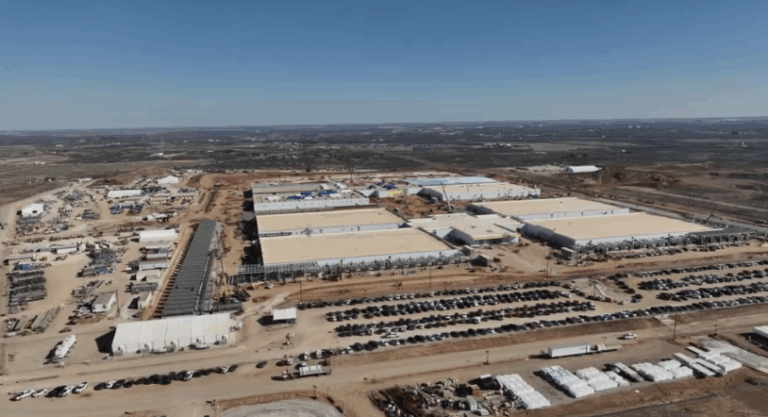
The investment flowing into AI infrastructure raises fundamental questions about returns and sustainability. Amazon, Google, Meta, and Microsoft spent approximately $400 billion in 2025 on AI infrastructure. OpenAI has targeted $1.4 trillion in data center spending over the next eight years. McKinsey estimates that datacenters equipped to handle AI workloads could require as much as $7.9 trillion in capital expenditure by 2030 to keep up with demand, while acknowledging that nobody is really sure what that level of demand will actually be.
Concerns have emerged about the circular nature of these investments. Nvidia’s $100 billion investment in OpenAI, in which OpenAI commits to filling new data centers with Nvidia chips, has drawn scrutiny from analysts who question whether such arrangements artificially inflate actual demand. Harvard Business School’s Andy Wu observes that it appears Nvidia is paying its customers to buy its products, a structure unusual at this scale outside the dot-com era. Michael Burry, who famously predicted the 2008 housing collapse, is now betting against Nvidia, arguing that true end demand is ridiculously small.
The profitability gap compounds these concerns. Menlo Ventures analysis found that only 3% of customers currently pay for AI services. OpenAI does not expect profitability for another five years. One financial analysis estimates that AI datacenters built in 2025 will suffer $40 billion of annual depreciation while generating somewhere between $15 and $20 billion of revenue. Even Sam Altman has acknowledged that investors as a whole are overexcited about AI, while Google’s Sundar Pichai told the BBC there are elements of irrationality in the current market.
Recent market signals suggest investors are beginning to recalibrate. CoreWeave’s stock has fallen more than 60% from its June 2025 peak, wiping $33 billion from its valuation. Oracle shares dropped 45% from September highs amid scrutiny of $248 billion in long-term lease commitments. Goldman Sachs warns that the AI boom now resembles tech stocks in 1997, several years before the dot-com bubble actually burst. Whether this represents a bubble or simply the capital intensity of transformative infrastructure remains uncertain. What matters is that financial pressures create additional urgency around whether current AI approaches will deliver proportional returns, or whether an AI paradigm shift will be required to justify such massive capital deployment.
The Structural Boundaries of Current Models
Beyond economic pressures, current AI architectures face technical boundaries that become visible when we ask for capabilities beyond pattern completion and language generation. Large language models excel at summarization, code assistance, and content creation, but turning these into high-trust autonomy, where systems act reliably within tight safety and economic constraints, is a fundamentally different challenge.
The evidence of diminishing returns from scaling is mounting. Ilya Sutskever, co-founder of OpenAI and Safe Superintelligence, has stated that pretraining as we know it will end because we have achieved peak data. TechCrunch reports that AI scaling laws, the methods and expectations used to increase model capabilities for the past five years, are now showing signs of diminishing returns. Anyscale co-founder Robert Nishihara, whose company helped OpenAI scale training workloads, acknowledges that in order to keep the rate of progress increasing, we also need new ideas.
Research on causal reasoning reveals structural limitations. When researchers tested whether LLMs can genuinely understand cause and effect, they found something revealing: these models excel at recognizing patterns they have seen during training, but struggle when asked to reason about cause and effect in genuinely new situations. When presented with novel scenarios constructed from information published after training cutoffs, performance dropped to near-random levels. In other words, LLMs can retrieve and recombine what humans have already written about causal relationships, but they cannot reliably figure out causal connections on their own.
Agentic AI, the current wave of systems designed to act autonomously, shows both potential and fragility. Gartner predicts that more than 40% of agentic AI projects will be canceled by the end of 2027 due to escalating costs, unclear business value, or inadequate risk controls. The research firm identifies widespread \”agent washing,\” where vendors rebrand existing chatbots and automation tools without delivering true autonomous capabilities. IBM researchers note that technology cannot be responsible, and the scale of risk from autonomous systems is higher because AI can act faster and in ways humans might not notice. These limitations point toward the necessity of an AI paradigm shift to achieve reliable autonomous capabilities.
What Genuine Autonomy Requires
The gap between today’s AI and dependable autonomy involves specific capabilities that current architectures struggle to deliver. The World Economic Forum identifies autonomous systems as the next AI frontier, noting they require convergence of sensing, connectivity, computing, and control, not isolated intelligence.
The distinction between prediction and planning is fundamental. Current LLMs predict what text comes next in a sequence. Genuine autonomy requires predicting what happens next in reality, understanding cause-and-effect relationships, and evaluating counterfactual scenarios before acting. A system that can describe what others have written about adjusting manufacturing parameters differs fundamentally from one that can simulate the actual consequences of that adjustment.
Additional requirements include long-horizon memory and context management, grounded learning from multimodal sensory observation rather than just text, and the ability to plan sequences of actions toward goals while handling uncertainty. These capabilities point toward architectures that build internal models of reality, a direction researchers are actively exploring under the umbrella of world models.
World Models and the Next Paradigm
Yann LeCun, Meta’s Chief AI Scientist and a pioneer in artificial intelligence, has proposed the Joint Embedding Predictive Architecture (JEPA) as a framework for developing more human-like AI systems. In his position paper A Path Towards Autonomous Machine Intelligence, LeCun outlines JEPA as an approach that can reason, plan, and understand the world in ways that current LLMs cannot. This represents a credible direction for the next AI paradigm shift.
The core distinction is architectural. Current LLMs learn by predicting the next token in a sequence, essentially performing sophisticated pattern completion on compressed text representations of human knowledge. JEPA learns by creating an internal model of the world, predicting outcomes in an abstract representation space rather than predicting pixels or tokens directly. This allows the system to focus on high-level, essential information and ignore irrelevant or unpredictable details.
Meta has released concrete implementations of this vision. I-JEPA (Image Joint Embedding Predictive Architecture) learns by comparing abstract representations of images rather than pixels themselves, requiring approximately five times fewer training iterations than comparable approaches. V-JEPA extends this to video, learning to understand and predict what is happening by predicting missing parts in abstract representation space. V-JEPA 2, released in June 2025, represents evolution from video understanding to a complete world model capable of prediction and planning, trained on over one million hours of internet video.
The practical implications are significant. Consider the difference: today’s LLMs can tell you what engineers have written about adjusting a manufacturing parameter, summarizing documentation and best practices from their training data. A world model, by contrast, could actually simulate the consequences of that adjustment before you make it, predicting how the change would ripple through the system. For industrial applications, scientific research, and any domain requiring reliable action in the physical world, this distinction matters enormously.
Signals That a Transition Is Approaching
While timing remains genuinely uncertain, observable indicators can help leaders recognize when the current paradigm is reaching its practical limits. The AI paradigm shift will likely become visible through several signals.
Several observable patterns can help identify when current approaches are reaching their limits. First, the cost of achieving each new improvement keeps rising while the improvements themselves get smaller. AI companies must spend exponentially more on computing power to achieve incrementally better results. Second, AI assistants designed to act autonomously keep stumbling over the same types of problems, particularly when using external tools, verifying their own work, or recovering from mistakes, and these issues persist even as the underlying models improve. Third, the supply of high-quality training material is running low; models have already consumed most of the high-quality text on the internet, forcing researchers to look elsewhere. Fourth, AI systems increasingly pass standardized tests and benchmarks while still failing in unpredictable ways when deployed in real-world situations.
A balanced perspective acknowledges nuance here. The core AI models themselves, such as GPT-4 or Claude, are improving more slowly than they did in prior years because simply making them larger no longer produces dramatic leaps in capability. Yet the products built on these models, including ChatGPT, Claude.ai, and Microsoft Copilot, continue to get noticeably better. This is not a contradiction: product improvements now come primarily from adding features around the model rather than from the model itself getting smarter. Companies have added web browsing so the AI can access current information, file analysis so it can read your documents, code execution so it can run calculations, and connections to company knowledge bases so it can answer questions specific to your organization. The underlying intelligence advances incrementally while the usefulness of the complete product advances substantially. LLMs will not disappear. They will remain the core reasoning engine inside increasingly capable product ecosystems.
Strategic Implications for Leaders
The appropriate response is neither dismissing current AI nor waiting passively for the next paradigm. Leaders should invest pragmatically in today’s capabilities while maintaining awareness of where the frontier is moving.
Capture value from current tools through workflow automation, knowledge retrieval, code assistance, and content generation. Build proprietary data advantages, recognizing that domain-specific knowledge unavailable to commoditized models will define differentiation. Design for human-AI collaboration, understanding that the boundary between human and machine capabilities will continue shifting. Monitor emerging architectural developments: world models that build internal simulations of how reality works rather than just predicting text; embodied AI that operates through physical robots and devices; and physical AI designed to perceive, reason about, and act in the real world. These represent credible directions for next-generation capabilities.
The World Economic Forum predicts that as AI takes over tasks like summarizing documents, analyzing data, and drafting reports, the most valuable human skills will shift toward capabilities that AI handles poorly: leading teams, navigating organizational politics, building client relationships, and making judgment calls in ambiguous situations. Preparing employees for this shift, whether through training programs or redesigning roles to emphasize these human-centric capabilities, may prove as important as selecting the right technology.
Looking Beyond the Bridge
The current moment in artificial intelligence is best understood as a bridge, not a destination. The capabilities transforming workflows today will likely become infrastructure available to everyone tomorrow. The technical boundaries of current approaches, combined with economic pressures around sustainability and returns, create conditions for evolution toward new architectures.
Whether world models and JEPA-style architectures represent the specific path forward remains to be proven through research and deployment. What seems increasingly clear is that the journey from prediction to genuine understanding, from pattern completion to causal reasoning, from language interfaces to autonomous action in the physical world, will require capabilities that current approaches struggle to deliver.
History suggests that today’s AI capabilities will eventually become standard infrastructure, available to everyone at low cost, just as cloud computing and databases did before them. When that happens, competitive advantage will shift to whatever capabilities remain rare and difficult to replicate. The leaders who thrive will be those who capture today’s value while keeping their eyes on tomorrow’s horizon, investing in what works now while preparing for what comes next. The AI paradigm shift may not arrive on any predictable schedule, but the direction of travel seems clear enough to warrant attention.
References
- Wingate, D., Burns, B. L., & Barney, J. B. (2025). Why AI Will Not Provide Sustainable Competitive Advantage. MIT Sloan Management Review. https://sloanreview.mit.edu/article/why-ai-will-not-provide-sustainable-competitive-advantage/
- Accenture. (2024). Competitive Advantage in the Age of AI. California Management Review. https://cmr.berkeley.edu/2024/10/competitive-advantage-in-the-age-of-ai/
- McKinsey & Company. (2025). The State of AI in 2025: Agents, Innovation, and Transformation. McKinsey QuantumBlack. https://www.mckinsey.com/capabilities/quantumblack/our-insights/the-state-of-ai
- Wu, A. (2025). Should U.S. Be Worried About AI Bubble? Harvard Gazette. https://news.harvard.edu/gazette/story/2025/12/should-u-s-be-worried-about-ai-bubble/
- Allyn, B. (2025). Here’s Why Concerns About an AI Bubble Are Bigger Than Ever. NPR. https://www.npr.org/2025/11/23/nx-s1-5615410/ai-bubble-nvidia-openai-revenue-bust-data-centers
- Goldman Sachs. (2025). AI Datacenter Boom Could End Badly. The Register. https://www.theregister.com/2025/12/12/ai_datacenter_investments_goldman/
- Temple, J. (2025). What Even Is the AI Bubble? MIT Technology Review. https://www.technologyreview.com/2025/12/15/1129183/what-even-is-the-ai-bubble/
- Zeff, M. (2024). Current AI Scaling Laws Are Showing Diminishing Returns. TechCrunch. https://techcrunch.com/2024/11/20/ai-scaling-laws-are-showing-diminishing-returns-forcing-ai-labs-to-change-course/
- Gartner. (2025). Gartner Predicts Over 40% of Agentic AI Projects Will Be Canceled by End of 2027. Gartner Newsroom. https://www.gartner.com/en/newsroom/press-releases/2025-06-25-gartner-predicts-over-40-percent-of-agentic-ai-projects-will-be-canceled-by-end-of-2027
- IBM. (2025). AI Agents in 2025: Expectations vs. Reality. IBM Think. https://www.ibm.com/think/insights/ai-agents-2025-expectations-vs-reality
- LeCun, Y. (2022). A Path Towards Autonomous Machine Intelligence. OpenReview. Meta AI. https://ai.meta.com/blog/yann-lecun-ai-model-i-jepa/
- Meta AI. (2024). V-JEPA: The Next Step Toward Advanced Machine Intelligence. Meta AI Blog. https://ai.meta.com/blog/v-jepa-yann-lecun-ai-model-video-joint-embedding-predictive-architecture/
- World Economic Forum. (2025). Bringing AI into the Physical World with Autonomous Systems. WEF Stories. https://www.weforum.org/stories/2025/01/ai-and-autonomous-systems/
- World Economic Forum. (2025). Educating a Future Workforce That Will Match AI Disruption. WEF Stories. https://www.weforum.org/stories/2025/10/education-disruptive-ai-workforce-opportunities/
- CausalProbe-2024. (2025). Unveiling Causal Reasoning in Large Language Models: Reality or Mirage? arXiv. https://arxiv.org/html/2506.21215v1
- CNBC. (2025). CoreWeave Collapse Sparks Fears of Cracks in AI Infrastructure Boom. CNBC Markets. https://www.cnbc.com/2025/12/15/ai-infrastructure-selloff-continues-broadcom-oracle-coreweave-shares-slide.html
- Fortune. (2025). Nvidia’s $100 Billion Investment in OpenAI Has Analysts Asking About Circular Financing. Fortune. https://fortune.com/2025/09/28/nvidia-openai-circular-financing-ai-bubble/
- Bain & Company. (2025). State of the Art of Agentic AI Transformation. Bain Technology Report 2025. https://www.bain.com/insights/state-of-the-art-of-agentic-ai-transformation-technology-report-2025/