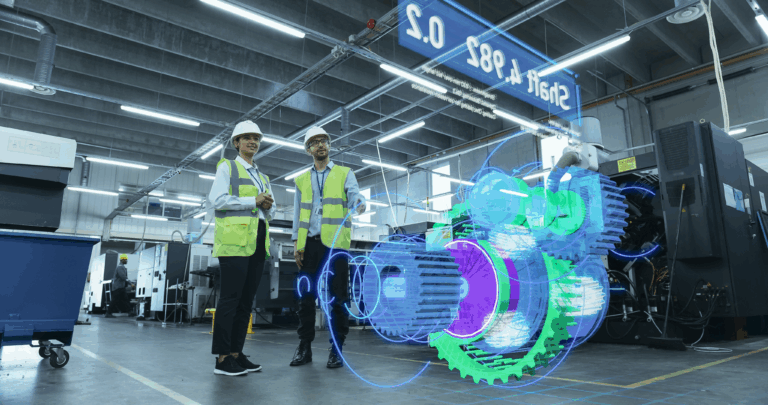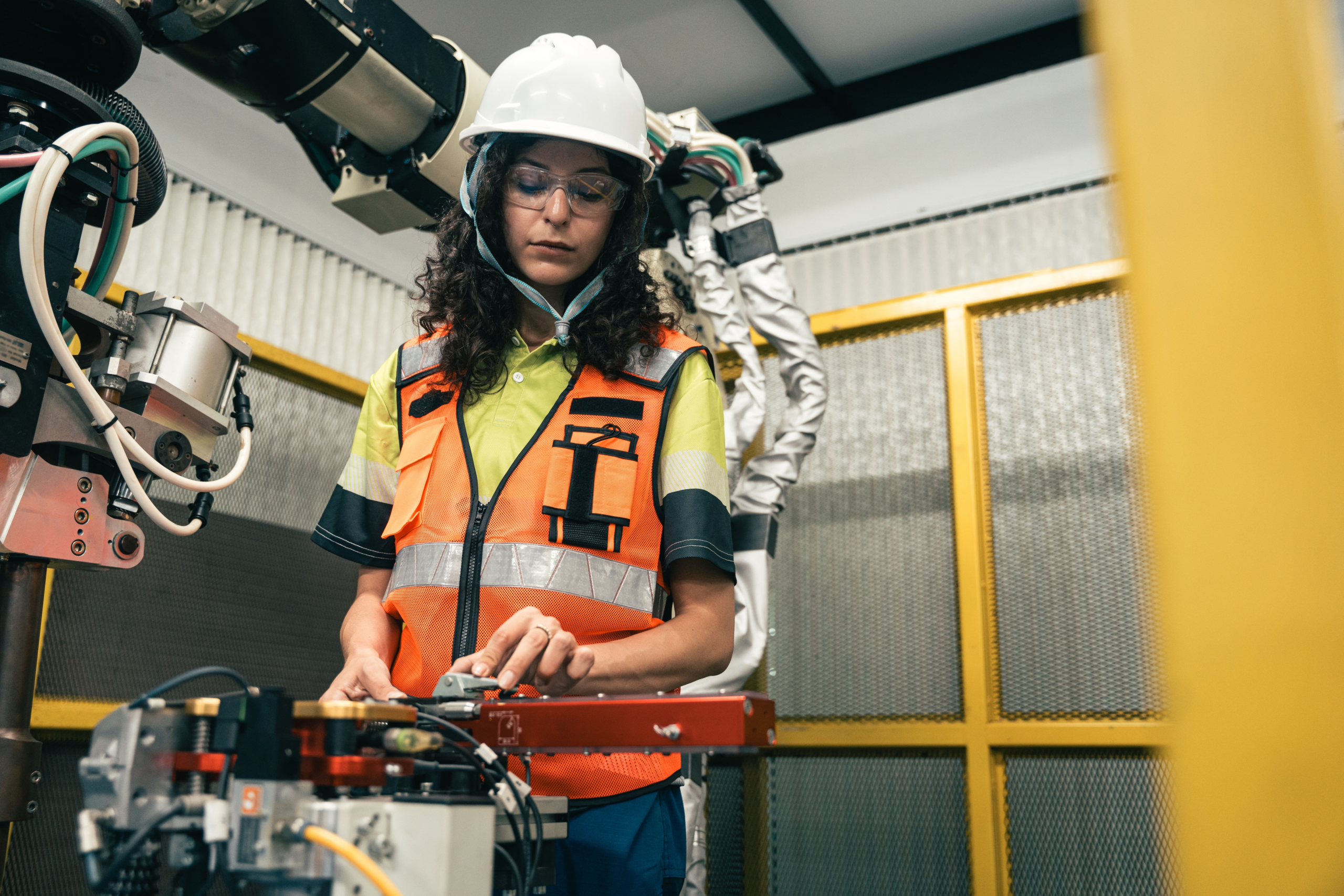

The factory floor is witnessing a profound shift. Artificial intelligence is evolving from passive tools that assist workers to active colleagues that collaborate, anticipate, and act alongside them. This is not a distant future scenario. It is happening now.
The urgency is clear. According to Deloitte, 1.9 million manufacturing jobs could go unfilled over the next decade if talent challenges are not addressed. Meanwhile, BCG research shows that 72% of workers already use AI regularly in their roles. For manufacturers facing persistent labor shortages and rising competitive pressure, the transformation toward agentic AI manufacturing is no longer optional. It is a strategic imperative.
Industrial AI assistants are moving beyond simple support functions to become true collaborators. They are reshaping workflows, augmenting human expertise, and redefining what it means to work on the shop floor.
The Copilot Era: Where It All Began
The concept of an AI copilot in manufacturing emerged as a way to support human workers with specific, bounded tasks. These systems help engineers generate code, guide technicians through troubleshooting procedures, and automate documentation. They respond to human commands and provide recommendations, but they do not act independently.
Siemens and Microsoft pioneered this approach with the Siemens Industrial Copilot, a generative AI-powered assistant designed explicitly for industrial environments. The results have been impressive. Engineers using the copilot can generate automation code with an estimated 60% reduction in time, while creating panel visualizations in 30 seconds. thyssenkrupp Automation Engineering has become one of the first companies to deploy the technology globally, using it to develop machines for electric vehicle battery quality inspections.
Yet the copilot model has limits. A 2024-2025 survey by Rootstock Software found that 53% of manufacturers prefer copilots as supportive tools rather than fully autonomous agents. Only 22% preferred AI agents, suggesting that trust in full automation remains limited. This reflects where the industry stands today: appreciating what copilots can deliver, but still cautious about handing over more control.
The Evolution: From Assistants to Colleagues
That caution is beginning to shift. A new generation of AI systems is emerging, and they are fundamentally different from copilots. These are AI agents: programs that interact with their environment, perceive data, and take autonomous action to achieve defined goals. This transition toward agentic AI manufacturing represents the next frontier for industrial operations.
The acceleration is striking. Gartner predicts that by 2028, 33% of enterprise software applications will incorporate agentic AI, up from less than 1% in 2024. The firm also forecasts that at least 15% of day-to-day work decisions will be made autonomously through agentic AI by that same year.
What does this mean in practice? AI systems that can schedule complex production lines, coordinate predictive maintenance across facilities, optimize quality control in real time, and communicate insights across departments without waiting for human direction. Microsoft describes this as a shift toward AI agents that enable organizations to gain insights, speed up innovation, and transform value chains.
The World Economic Forum’s Future of Jobs Report 2025 captures this evolution in concrete terms. Today, employers estimate that 47% of work tasks are performed primarily by humans, 22% by technology, and 30% through collaboration. By 2030, these proportions are expected to shift toward a near-even split between human, machine, and hybrid approaches. The rise of agentic AI manufacturing is making genuine human-AI partnership a reality.
On the Shop Floor: Real-World Transformation
These changes are not theoretical. They are unfolding in factories around the world.
At thyssenkrupp Automation Engineering in Chemnitz, Germany, engineers are using the Siemens Industrial Copilot to program machines that build EV battery assembly lines. The AI assistant automates repetitive tasks like data management, sensor configuration, and compliance reporting. It generates structured control language code for programmable logic controllers and integrates it directly within the engineering platform. Marcel Pfeiffer, thyssenkrupp’s director of digital factory solutions, explained the motivation: “We’re facing a shortage of skilled workers, not only in Germany but in Europe and the US. We want to enable less experienced engineers to be able to write coding in a short time.”
The transformation extends beyond engineering into daily operations. AI assistants can now translate machine error codes into plain language and offer actionable suggestions based on operational history and technical documentation. The result is less downtime, faster troubleshooting, and greater confidence for operators who may lack years of experience.
Predictive maintenance represents another frontier. MIT Technology Review reports that digital twins integrated with AI now provide real-time visualization of entire production lines, not just individual machines. In high-speed industries where downtime costs can reach $1.3 million per hour, the ability to predict failures before they occur delivers enormous value. Companies using these capabilities can target improvements with precision, saving millions in lost productivity without disrupting ongoing operations.
Quality control is also being transformed. AI-driven machine vision allows robots to see, analyze, and respond to their environment in real time. Collaborative robots, or cobots, now work safely alongside human operators on tasks ranging from assembly and welding to packaging and inspection. The shift toward agentic AI manufacturing is expanding into every corner of the factory.
The Human Dimension: Workforce Implications
The productivity gains are real. PwC’s 2025 Global AI Jobs Barometer found that industries most exposed to AI are experiencing nearly four times higher growth in labor productivity compared to less exposed sectors. Workers with AI skills command a 56% wage premium, double the figure from the previous year.
But realizing these benefits requires addressing a significant challenge. The World Economic Forum estimates that 59% of the global workforce will need training by 2030, and 63% of employers identify skills gaps as the biggest barrier to business transformation.
BCG’s research reveals another concern: a “silicon ceiling” separating leadership from the front line. While more than three-quarters of leaders and managers use generative AI several times a week, regular use among frontline employees has stalled at 51%. This gap threatens to limit the value that agentic AI manufacturing can deliver.
The companies seeing the best results are those investing in their people. BCG found that employees who receive at least five hours of AI training are significantly more likely to become regular users. Strong leadership support also makes a difference. When leaders actively champion AI adoption, the share of employees who feel positive about the technology rises from 15% to 55%.
New roles are emerging as well. McKinsey notes that companies are hiring agent product managers, AI evaluation writers, and “human in the loop” validators to guide machine output. The workforce is not shrinking. It is transforming.
Looking Ahead: The Factory of 2030
The trajectory is clear. The International Federation of Robotics reports that global robot density has doubled in just seven years, reaching 162 units per 10,000 manufacturing employees in 2023. Collaborative robots represent the fastest-growing segment as companies seek automation that works alongside humans rather than replacing them.
Government investment is accelerating. The U.S. National Institute of Standards and Technology is funding a new Manufacturing USA institute focused on AI for resilient manufacturing, with $70 million in federal support over five years. The goal is to develop a world-leading workforce capable of deploying AI technologies into industrial practice.
The vision taking shape is one of self-optimizing manufacturing ecosystems. AI agents will coordinate across the entire value chain, from design and planning through engineering, operations, and service. Copilots were the first step. Agentic AI manufacturing is what comes next: a true partnership between human expertise and machine intelligence.
Conclusion
The shift from copilots to colleagues is not about replacing human workers. It is about redefining collaboration itself. Manufacturers who embrace agentic AI manufacturing, invest in workforce development, and redesign their workflows will lead their industries. Those who wait risk being left behind.
The shop floor of tomorrow will be built on this new foundation. The future belongs to organizations that understand a simple truth: the most powerful factory is one where humans and AI work as true colleagues.
References
- Boston Consulting Group. “AI at Work 2025: Momentum Builds, But Gaps Remain.” BCG, June 2025. https://www.bcg.com/publications/2025/ai-at-work-momentum-builds-but-gaps-remain
- Deloitte. “2025 Deloitte Manufacturing Trends: From a Workday Lens.” Deloitte Global, 2025. https://www.deloitte.com/global/en/alliances/workday/perspectives/deloitte-manufacturing-trends-from-a-workday-lens.html
- Gartner. “Gartner Survey Shows 49% of Organizations Lack Confidence in Future Manufacturing Strategy.” Gartner Newsroom, October 2025. https://www.gartner.com/en/newsroom/press-releases/2025-10-28-gartner-survey-shows-49-percent-of-organizations-lack-confidence-in-future-manufacturing-strategy
- IIoT World. “Industrial Copilots: AI Assistants Reshaping Manufacturing.” IIoT World, August 2025. https://www.iiot-world.com/artificial-intelligence-ml/artificial-intelligence/industrial-copilots-ai-manufacturing/
- International Federation of Robotics. “Global Robot Density in Factories Doubled in Seven Years.” IFR Press Release, November 2024. https://ifr.org/ifr-press-releases/news/global-robot-density-in-factories-doubled-in-seven-years
- McKinsey & Company. “The State of AI in 2025: Agents, Innovation, and Transformation.” McKinsey, November 2025. https://www.mckinsey.com/capabilities/quantumblack/our-insights/the-state-of-ai
- Microsoft. “Industrial AI in Action: How AI Agents and Digital Threads Will Transform the Manufacturing Industries.” Microsoft Industry Blogs, March 2025. https://www.microsoft.com/en-us/industry/blog/manufacturing-and-mobility/manufacturing/2025/03/25/industrial-ai-in-action-how-ai-agents-and-digital-threads-will-transform-the-manufacturing-industries/
- Microsoft. “Siemens and Microsoft Scale Industrial AI.” Microsoft News, October 2024. https://news.microsoft.com/source/2024/10/24/siemens-and-microsoft-scale-industrial-ai/
- MIT Technology Review. “Scaling Innovation in Manufacturing with AI.” MIT Technology Review, November 2025. https://www.technologyreview.com/2025/11/19/1128067/scaling-innovation-in-manufacturing-with-ai/
- National Institute of Standards and Technology. “NIST Announces Funding Opportunity for AI-Focused Manufacturing USA Institute.” NIST News, July 2024. https://www.nist.gov/news-events/news/2024/07/nist-announces-funding-opportunity-ai-focused-manufacturing-usa-institute
- PwC. “AI Linked to a Fourfold Increase in Productivity Growth and 56% Wage Premium: PwC Global AI Jobs Barometer.” PwC Press Release, June 2025. https://www.pwc.com/gx/en/news-room/press-releases/2025/ai-linked-to-a-fourfold-increase-in-productivity-growth.html
- Stave, Jen, Ryan Kurt, and John Winsor. “Agentic AI Is Already Changing the Workforce.” Harvard Business Review, May 2025. https://hbr.org/2025/05/agentic-ai-is-already-changing-the-workforce
- World Economic Forum. “The Future of Jobs Report 2025.” World Economic Forum, January 2025. https://www.weforum.org/publications/the-future-of-jobs-report-2025/digest/
- Association for Advancing Automation. “2024 North American Robotics Market Demonstrates Stability After Volatile Growth.” A3/Manufacturing Automation, February 2025. https://www.automationmag.com/a3-2024-north-american-robotics-market/