
- Introduction: Unlocking the Quantum Potential
Quantum computing is not just the next step in computational evolution—it’s a leap into a future where once-unsolvable problems become solvable. While classical computers process data as binary bits (0s and 1s), quantum computers leverage quantum bits, or qubits, which can exist in multiple states simultaneously thanks to principles like superposition and entanglement. This extraordinary capability enables quantum computers to perform complex calculations exponentially faster than their classical counterparts. Imagine modeling the behavior of molecules to discover new drugs in weeks instead of decades or optimizing entire global supply chains in real time. Quantum computing promises not just incremental progress but transformative breakthroughs that redefine what is computationally possible.
- A Brief History of Quantum Computing
The seeds of quantum computing were planted in the 1980s when physicists like Richard Feynman and David Deutsch began exploring how the principles of quantum mechanics could be applied to computation. Feynman famously proposed that classical computers might never effectively simulate quantum systems, sparking the need for an entirely new computational paradigm. Over the next few decades, theoretical concepts matured into practical experimentation. In 2019, Google claimed “quantum supremacy” by performing a computation in seconds that would have taken classical computers thousands of years. Today, organizations like IBM, Google, and startups such as IonQ and Rigetti are racing to scale quantum systems, turning theoretical potential into real-world impact.
- Revolutionary Opportunities
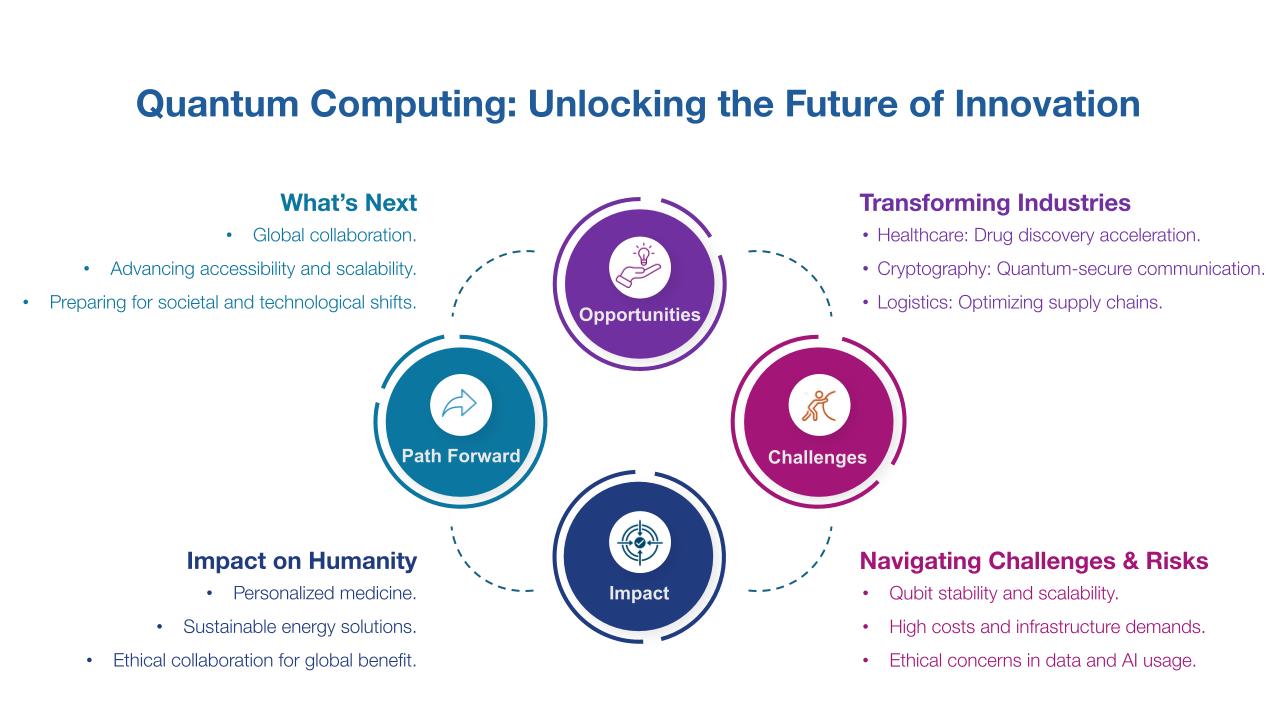
Quantum computing is poised to transform industries by tackling problems that are currently unsolvable with classical computers. Its ability to process vast datasets, analyze complex systems, and simulate real-world conditions at unprecedented speeds offers immense potential across multiple fields. Among the most promising areas are drug discovery, cryptography, and logistics optimization.
- Drug Discovery: A Catalyst for Medical Breakthroughs
In the pharmaceutical industry, the discovery and development of new drugs often take years of trial and error, with costs running into billions of dollars. Quantum computing promises to revolutionize this process by enabling accurate simulations of molecular interactions. Using quantum algorithms, researchers can analyze how a drug interacts with proteins or cells at the atomic level, dramatically speeding up the identification of promising compounds.
For example, Merck and IBM are leveraging quantum systems to model protein folding, a notoriously complex problem that classical computers struggle to handle. By simulating these interactions, quantum computing could help scientists design drugs that are more effective and have fewer side effects, significantly reducing time-to-market. In the future, this technology could also lead to personalized medicine, where treatments are tailored to an individual’s genetic profile, ushering in a new era of healthcare innovation.
- Cryptography: Reinventing Security in a Quantum World
Quantum computing presents both a challenge and an opportunity in the realm of cryptography. Classical encryption methods, such as RSA, rely on the computational difficulty of factoring large prime numbers—an operation that quantum computers could perform exponentially faster using algorithms like Shor’s algorithm. This potential capability has raised concerns about the vulnerability of existing encryption systems, which could be rendered obsolete.
However, quantum computing also enables the creation of quantum-safe cryptographic methods. One such example is Quantum Key Distribution (QKD), a method that uses quantum properties to create virtually unhackable communication channels. China’s Micius satellite has successfully demonstrated QKD, transmitting encrypted data over long distances with unparalleled security. As quantum computers advance, industries and governments must adopt quantum-resistant encryption methods to safeguard sensitive information in finance, defense, and communications.
- Logistics Optimization: Redefining Efficiency in Global Supply Chains
Modern logistics is a complex web of interconnected operations, from inventory management to delivery route optimization. Quantum computing can revolutionize logistics by processing and analyzing massive amounts of data in real time to optimize these systems. For example, Volkswagen has used D-Wave’s quantum computers to optimize traffic flow in Lisbon, demonstrating how quantum algorithms can reduce congestion, save fuel, and improve urban mobility.
In supply chain management, quantum computing can predict disruptions and reroute shipments dynamically, minimizing delays and costs. Imagine a global logistics network where quantum systems instantly analyze weather patterns, geopolitical events, and market trends to ensure smooth operations. For e-commerce giants like Amazon, this could translate into faster deliveries, reduced waste, and significant cost savings, all while enhancing customer satisfaction.
- Challenges and Risks
Despite its promise, quantum computing faces significant hurdles. The technology depends on qubits, which are incredibly fragile and prone to errors due to quantum decoherence—a phenomenon where quantum states lose their stability when exposed to external factors like heat or noise. Building a large-scale, error-free quantum computer requires advancements in hardware and error correction that are still years, if not decades, away. Costs remain prohibitive, with quantum systems requiring ultra-cold environments and cutting-edge materials. Additionally, there are risks. Quantum computing could disrupt current encryption methods, exposing sensitive data and creating new cybersecurity vulnerabilities. Furthermore, as with any transformative technology, ethical concerns loom: Will quantum power be concentrated in the hands of a few corporations, or can it be democratized to serve humanity as a whole?
- The Human Impact
The impact of quantum computing on humanity could be profound. In medicine, it offers hope for curing diseases faster and developing personalized treatments tailored to an individual’s genetic makeup. In energy, quantum algorithms could optimize renewable energy grids, making sustainable energy sources more efficient and accessible. Yet, this technological power also comes with moral responsibilities. How do we ensure that quantum computing is used ethically, fostering collaboration rather than competition? Will it widen the gap between technologically advanced nations and those that lag behind? The choices we make today about how this technology is developed and deployed will shape its impact for generations to come.
- The Path to Quantum Adoption: Collaboration and Innovation
As promising as quantum computing is, its journey from laboratory experiments to mainstream applications requires a global, collaborative effort across governments, academia, and industry. The adoption of quantum technology hinges on solving critical barriers such as scalability, error correction, and accessibility.
Governments are investing heavily in national quantum initiatives, such as the U.S. National Quantum Initiative Act and Europe’s Quantum Flagship program, to drive innovation and establish regulatory frameworks. IBM, Google, and startups like IonQ are racing to refine quantum hardware and develop user-friendly platforms that democratize quantum access for businesses. Meanwhile, academia plays a key role in advancing foundational research and training the next generation of quantum scientists and engineers.
Collaboration between these sectors will accelerate breakthroughs, reduce costs, and ensure quantum computing benefits are widely distributed. By addressing technical and economic challenges, quantum computing has the potential to move from an emerging technology to a transformative force that shapes the future of innovation.
- Conclusion: A Quantum Leap for Humanity
Quantum computing is not just a technological revolution; it’s a profound shift in how we solve problems and envision the future. By addressing challenges in healthcare, climate, logistics, and beyond, it has the potential to become one of humanity’s most transformative tools. Yet, its development must be approached with both ambition and caution, ensuring it serves as a force for progress and equity. As quantum systems continue to mature, they offer a glimpse into a world where limitations give way to possibilities, enabling us to tackle the greatest challenges of our time and unlocking new frontiers of human achievement.
References
- IBM Research: Quantum computing in chemistry. Available at: https://www.ibm.com/blog/quantum-computing-chemistry/
- Merck partnership with quantum startups. Available at: https://www.merck.com
- Nature Communications: Quantum algorithms for chemistry. Available at: https://www.nature.com/articles
- Micius Satellite experiment: Quantum Key Distribution. Available at: https://www.nature.com
- NIST post-quantum cryptography initiatives. Available at: https://www.nist.gov
- MIT Technology Review: Quantum-safe cryptography and encryption. Available at: https://www.technologyreview.com
- Volkswagen’s quantum traffic optimization. Available at: https://www.volkswagen-newsroom.com
- D-Wave quantum logistics applications. Available at: https://www.dwavesys.com
- Amazon and quantum logistics applications. Available at: https://www.amazon.science
- Google’s Quantum Supremacy milestone. Available at: https://www.nature.com/articles
- Quantum applications in finance: JP Morgan Chase. Available at: https://www.jpmorgan.com